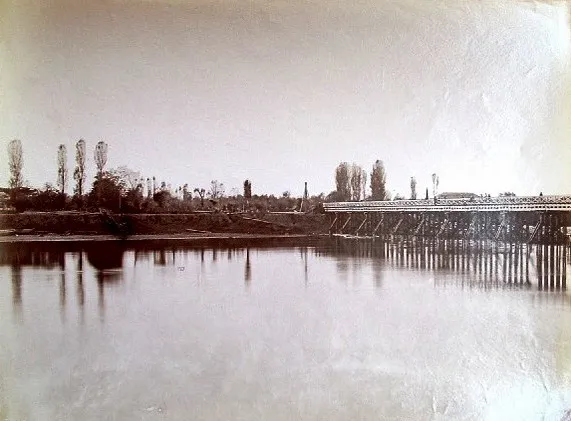
The Town That Existed Twice: How a Spelling Mistake Turned a Small Ohio River Community Into a Phantom Metropolis

A Clerical Error With Surprisingly Large Consequences
In the summer of 1890, somewhere in the Census Bureau's Washington offices, a clerk made a small mistake. Not a dramatic one. Not the kind you'd notice without squinting. Just a letter or two transposed in the name of a modest Ohio river town — the sort of thing that happens when you're transcribing thousands of handwritten survey forms in an era before spellcheck, computers, or, apparently, anyone comparing one entry to the next.
 Photo: Census Bureau, via i.pinimg.com
The result was that one real town became two entries in the federal record. And for nearly a decade, those two entries sat side by side in official population charts, each reporting thousands of residents, together suggesting a combined urban center large enough to rank among the more significant communities in the state.
It was, in the most literal sense, a city that didn't exist. And the federal government spent real money on it.
How the 1890 Census Worked — and Why It Was Vulnerable
The 1890 census was the most ambitious count the United States had ever attempted. The country was growing at a pace that strained every system designed to measure it. Enumerators fanned out across every state, collecting data by hand, returning forms to regional offices where clerks transcribed them into ledgers, which were then forwarded to Washington for compilation.
The process was enormous, mostly accurate, and deeply human — which is to say, prone to exactly the kind of error that struck the Ohio river town in question. The town's name, rendered in the regional dialect and handwriting of a local enumerator, came back to Washington looking subtly different from the same town's name as it appeared in an earlier administrative record. To the clerks assembling the master ledger, these looked like two distinct places.
Both entries were logged. Both were counted. And because the populations were recorded separately, the totals for each phantom municipality were added to Ohio's overall count without anyone noticing they described the same streets, the same houses, and the same people.
The Numbers That Changed Real Decisions
Here is where the story moves from amusing to genuinely consequential.
Federal funding allocations in the 1890s were tied, in various ways, to population data. Road construction priorities, postal service expansion, and infrastructure investment were all calibrated against census figures. A town that appeared to have a substantial population attracted resources. A town that appeared to have twice that population attracted more.
The phantom Ohio community, with its doubled headcount, briefly appeared on federal charts as one of the more sizable population centers in its region. Funding decisions followed. Road projects were prioritized. Postal infrastructure was expanded. And in the background, the census figures fed into the congressional reapportionment process — the mechanism by which states gain or lose seats in the House of Representatives based on population shifts.
Whether the doubled count directly influenced Ohio's seat allocation remains a matter of some historical debate. What is not debated is that federal dollars flowed toward a population that was, in a strict mathematical sense, imaginary.
The Statistician Who Noticed
The error might have survived indefinitely — census records of that era were not routinely cross-checked with the thoroughness that later became standard — except for one detail. A federal statistician working on a regional economic study in the late 1890s noticed something strange while comparing the Ohio population data to property tax records from the same period.
The two entries for the Ohio town showed nearly identical economic profiles. The same approximate number of households. The same general income distribution. The same patterns of commercial activity. The odds of two separate towns in the same county sharing that level of statistical similarity were, the statistician noted in his report, essentially zero.
He flagged the discrepancy. An investigation followed. The conclusion was not especially difficult to reach once someone was actually looking: the town had been counted twice, under two slightly different spellings, and the federal record had accepted both without question.
The Town's Surprisingly Practical Response
You might expect local officials to be embarrassed. Some were. But embarrassment was quickly overtaken by a more pressing concern: a significant portion of the federal funding that had flowed toward the town based on its phantom population had already been spent.
The roads had been graded. The postal routes had been established. The improvements existed. And local officials, with a pragmatism that is difficult to entirely fault, argued that returning the money — or retroactively reclassifying the town's population downward — would punish a real community for a mistake made in Washington.
They petitioned to keep the corrected population figure from appearing in any official summary that might trigger a funding clawback. They were not entirely unsuccessful. The correction was made in the internal census record, but the published summaries for the decade were not reissued. The phantom city quietly ceased to exist in the paperwork without anyone having to formally explain why the money had already been spent on it.
The Quirk That Outlasted the Error
What makes this story worth telling isn't just the mistake itself — it's the way the mistake traveled through systems that were designed to be reliable and left real marks on a real place. The roads built with phantom-population funding are still there. The postal infrastructure expanded during that period still shapes how the region is served.
A town that never had the population Washington thought it did got infrastructure sized for a city it wasn't. And in some small, concrete ways, that infrastructure helped it eventually grow into something closer to what the census had accidentally claimed it already was.
The ledger was wrong. The outcome was complicated. And somewhere in an Ohio county that doesn't advertise this particular chapter of its history, there are roads that exist because a clerk in 1890 couldn't quite read someone else's handwriting.