Funny Money in the Desert: The Remote American Town That Printed Its Own Cash for Four Decades
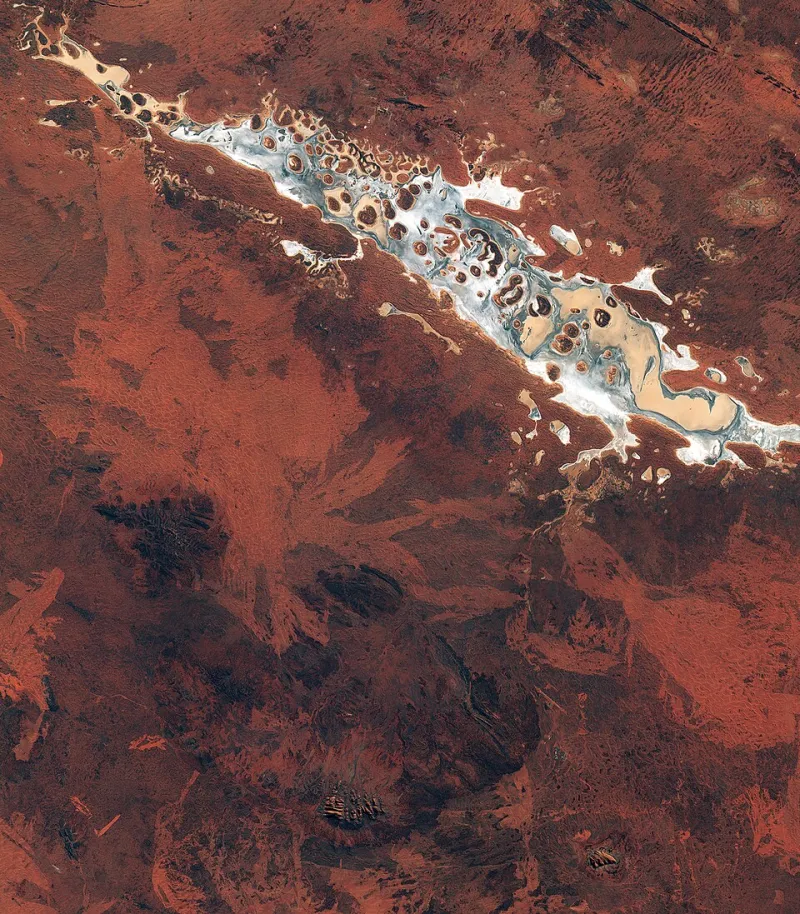
Photo: European Space Agency, CC BY-SA 3.0 igo, via Wikimedia Commons
The Dollar Didn't Reach This Far
There is a particular kind of American remoteness that doesn't fully register until you try to get there. Not scenic remoteness, not the kind that gets written up in travel magazines — the other kind. The kind where the nearest federal office is a day's travel in good weather, where mail arrives when conditions allow, and where the abstract machinery of national governance feels about as relevant as news from a foreign country.
In the early twentieth century, a small community in the American Southwest occupied exactly that kind of remoteness. The town had a name, a post office (theoretically), a general store, and a local economy built around mining, small-scale agriculture, and a rotating cast of traders who came through on irregular schedules. What it did not have, in any practical sense, was reliable access to U.S. currency.
So it made its own.
How You Build a Parallel Economy
The currency the town used was scrip — printed paper notes issued locally, redeemable at the general store and accepted by most businesses and individuals within the community. Scrip itself was not unusual in the American West. Company towns had used it for decades, and during economic crunches, informal local currencies had appeared in communities all across the country.
What made this town's situation unusual was the timeline. By the point this community had settled into its scrip-based economy as a permanent arrangement, federal law had already moved to consolidate monetary authority firmly with the national government. Locally issued currencies operating outside the federal system were not, strictly speaking, legal.
The town kept printing anyway.
The reasons were practical rather than ideological. The nearest federal bank was genuinely inaccessible for significant portions of the year. The scrip worked. Everybody knew what it was worth, everybody accepted it, and the local economy hummed along with a stability that many larger communities would have envied. The man who ran the general store — who was also, in practice, the town's de facto monetary authority — maintained a ledger of outstanding scrip with the kind of careful bookkeeping that would have impressed a bank examiner, had any bank examiner ever showed up.
None did. For approximately forty years.
The Bureaucratic Blind Spot
Federal monetary oversight in the early and mid-twentieth century was, in theory, comprehensive. In practice, it had significant geographic blind spots. Remote communities in the Southwest — particularly those with small populations, minimal economic output by national standards, and poor road access — simply did not appear on the enforcement radar.
The town's scrip economy wasn't hidden, exactly. Local residents didn't think of themselves as operating a criminal enterprise. They thought of themselves as solving a practical problem with available tools. Traders who passed through accepted the scrip or negotiated exchanges at agreed rates. The system was, by any functional measure, money — it stored value, facilitated exchange, and was accepted by the community that used it.
What it was not was federally authorized. And for four decades, that distinction didn't matter to anyone who lived there.
When Washington Finally Showed Up
The end of the arrangement came not with a dramatic raid or a federal prosecution, but with the particular anticlimax that tends to characterize the resolution of long-running bureaucratic oversights.
Improved road access brought the town into closer contact with the broader regional economy. A new federal initiative to extend banking services to underserved rural communities sent officials into areas that had previously been considered too remote to bother with. When those officials arrived and began surveying the local economic landscape, they encountered the scrip system with the confused expression of people who had prepared for a routine visit and found something considerably more interesting.
The records suggest a period of genuine institutional uncertainty about how to respond. The scrip had been technically illegal for decades. But prosecuting a community for solving a problem the federal government had failed to solve — namely, getting actual currency to places that needed it — was not a straightforward proposition. The people involved were not fraudsters. They were farmers and miners who had built a functional economy out of necessity.
The resolution was quiet. The scrip was phased out. Federal banking access was extended. The ledger kept by the general store owner was reviewed, found to be scrupulously accurate, and then apparently filed somewhere it was never discussed publicly again.
What the Funny Money Actually Proved
Economists who have studied historical scrip systems tend to reach a consistent conclusion: they work, under the right conditions. A community that trusts its local currency, has a stable issuing authority, and operates within a well-understood economic boundary can sustain a functional monetary system almost indefinitely.
The Southwest town demonstrated this with forty years of real-world evidence. Its economy didn't collapse. Its currency didn't inflate into worthlessness. The general store owner's ledger balanced.
What eventually ended the arrangement wasn't economic failure. It was a road.
Sometimes the most subversive thing a government can do to a community running its own parallel civilization is simply make it easier to reach.