For Forty Years, a Radio Station Broadcast from Inside the Wrong Country
The Cold War produced a remarkable number of things that were built quickly, classified heavily, and documented poorly. Most of those secrets eventually surfaced in an orderly way — declassified files, congressional hearings, the occasional tell-all memoir. But occasionally, something surfaces that doesn't fit any of the expected categories. Something that isn't really a secret so much as a mistake so large and so quietly sustained that it defies easy explanation.
This is the story of a radio transmission facility that spent four decades broadcasting from inside the wrong country — and how nobody involved, on either side of the border, had any idea.
The Mountain and the Mission
In the early 1950s, the United States government was deeply invested in building communications infrastructure that could survive a nuclear exchange. Part of that effort involved identifying geologically stable sites — preferably mountainous terrain — where transmission equipment could be buried deep enough to remain operational even under significant external disruption.
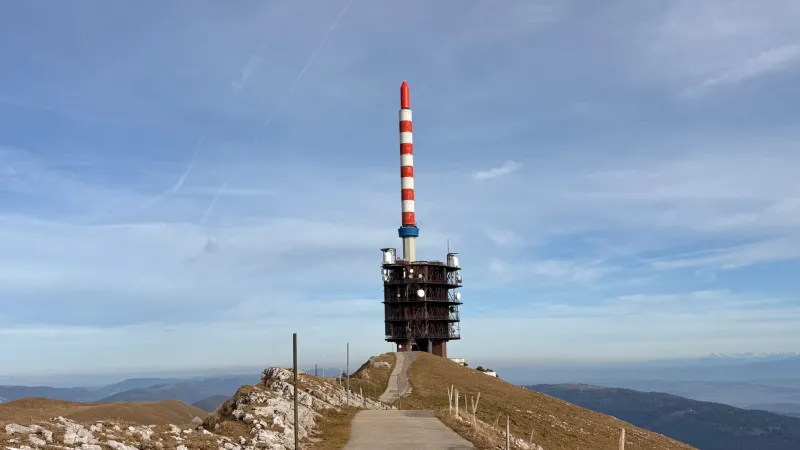
One such facility was constructed in a remote stretch of mountainous terrain along the U.S.-Canada border in the Pacific Northwest. The specifics of its mission have never been fully declassified, but its general function was radio transmission — signals that needed to travel long distances with minimal interference and maximum reliability.
The facility was bored directly into the mountain. Construction crews worked from the American side. The project used survey data that had been compiled in the 1930s, updated piecemeal, and — as would eventually become clear — contained an error in the mapped position of the international boundary.
The Error Nobody Found
The U.S.-Canada border through mountainous terrain is not a simple thing to survey. In flat country, the 49th parallel is a line on a map that corresponds, more or less, to a line on the ground. In serious mountain country, that correspondence gets complicated fast. Elevation changes, geological features, and the practical limits of 19th- and early 20th-century surveying equipment all introduced inconsistencies that were periodically corrected — but not always comprehensively.
The survey data used for the facility's construction placed the relevant section of the border approximately 340 feet east of where it actually ran. This is not an enormous error in absolute terms. In terms of a tunnel bored horizontally into a mountain, it was enough.
The facility's deepest operational chambers — the ones housing the primary transmission equipment — sat on the Canadian side of the line.
For roughly forty years, American government personnel operated American government equipment from inside Canadian territory, completely without authorization, completely without awareness, and completely without incident. The signals went out. The facility was maintained. Reports were filed. Nobody checked the maps.
How It Came Out
The discovery, when it finally came, arrived through the least dramatic possible channel: a routine border survey modernization project in the early 1990s, conducted jointly by American and Canadian geodetic authorities using GPS technology that simply hadn't existed when the original surveys were done.
The surveyors flagged the discrepancy as a data anomaly. It was cross-referenced against known infrastructure in the area. Someone, eventually, made the connection to the facility.
What followed was, by all accounts, one of the more unusual diplomatic conversations in recent U.S.-Canada relations — a relationship not generally known for producing unusual diplomatic conversations. Canadian authorities were, officially, surprised. American authorities were, officially, apologetic. Both governments were, practically speaking, deeply uncertain about what the correct response was.
The facility was no longer operational by this point, having been decommissioned sometime in the mid-1980s as satellite communication made its original function obsolete. This helped considerably. There was no ongoing violation to address — only a historical one, spanning four decades, for which no legal framework had ever been designed.
The Legal Nowhere Zone
International law has frameworks for a lot of things. Territorial disputes. Accidental border crossings. Unauthorized military installations. What it doesn't have — or didn't, at the time — is a clean mechanism for resolving forty years of inadvertent, completely good-faith operation of a communications facility in the wrong country.
Both governments agreed, with some relief, that the facility was decommissioned and the question was therefore largely academic. A quiet diplomatic note was exchanged. A correction was made to the official border survey records. No formal apology was issued publicly. No congressional hearing was convened.
Canadian officials, for their part, noted that the facility had not been used for any purpose that affected Canadian interests and expressed satisfaction that the matter had been resolved cooperatively. American officials agreed that it had.
And that, more or less, was that.
The Quiet Lesson
What makes this story stick isn't the espionage angle — there isn't one, really. It's the sheer mundane persistence of the error. For forty years, people showed up to work at a facility that was, by any legal definition, not in the country they thought it was in. They filed paperwork. They drew salaries. They maintained equipment. The institution around them functioned exactly as institutions function: with confidence, with routine, and with no particular reason to question whether the ground beneath it was actually theirs.
Somewhere in a filing cabinet, there are almost certainly forty years of maintenance logs from a facility that was, technically, operating on foreign soil.
The mountain didn't care. The signals went out just fine.