Nothing Original Remains: The Pennsylvania Bridge That Legally Stayed the Same While Becoming Completely Different
A Bridge That Couldn't Quite Hold Its Own Weight
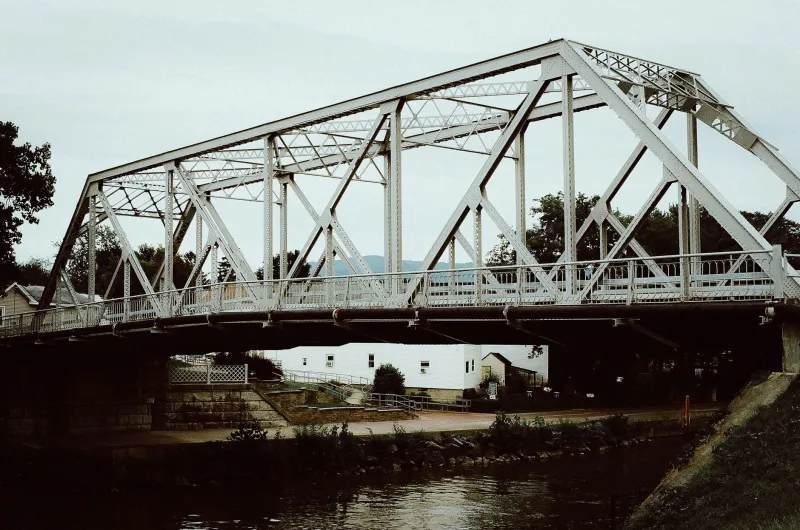
Somewhere in the paperwork of 19th-century American infrastructure, there is a bridge that is both completely original and entirely fake. Not a replica. Not a restoration. The same bridge — certified, documented, insured — that just happens to share zero physical components with the structure that opened in 1872.
It sounds like a riddle. It was actually a bureaucratic crisis that took the federal government the better part of a century to untangle.
When the iron truss bridge was completed in western Pennsylvania in the early 1870s, it represented exactly the kind of confident, can-do engineering that defined the era. Railroads were threading through every valley. Iron was the future. And load-tolerance calculations, while not yet the precise science they would become, were considered reliable enough to build on.
Except in this case, they weren't quite right.
The Quiet Problem Nobody Wanted to Say Out Loud
The miscalculation wasn't dramatic. The bridge didn't buckle. Nobody fell into the river. Instead, the structure began showing what engineers of the period called "chronic fatigue" — a pattern of stress fractures and warped components that appeared on a timeline faster than it should have. By the mid-1880s, the county engineer responsible for the crossing had a quiet understanding with the iron fabricators down the road: components would be swapped out on a rolling basis, starting with the most stressed sections.
This was not unusual practice. Maintenance and component replacement were standard parts of bridge management. What made this situation different was the pace and the scope. Within fifteen years, the replacement schedule had accelerated to the point where entire sections were being rebuilt rather than patched. By 1910, structural historians would later estimate, less than forty percent of the original iron remained in place.
And yet the paperwork never changed. The bridge was still logged under its original construction date. Insurance premiums were calculated against its original specifications. When the state conducted its periodic infrastructure certifications, inspectors noted repairs but never reclassified the structure. It was, on paper, the same bridge it had always been.
Ship of Theseus, But With Federal Funding
Philosophers have argued for centuries about the Ship of Theseus — the thought experiment asking whether a vessel that has had every plank replaced remains the same ship. It's a satisfying abstract puzzle in a seminar room. It becomes considerably less abstract when federal highway funding, insurance liability, and historical preservation status are riding on the answer.
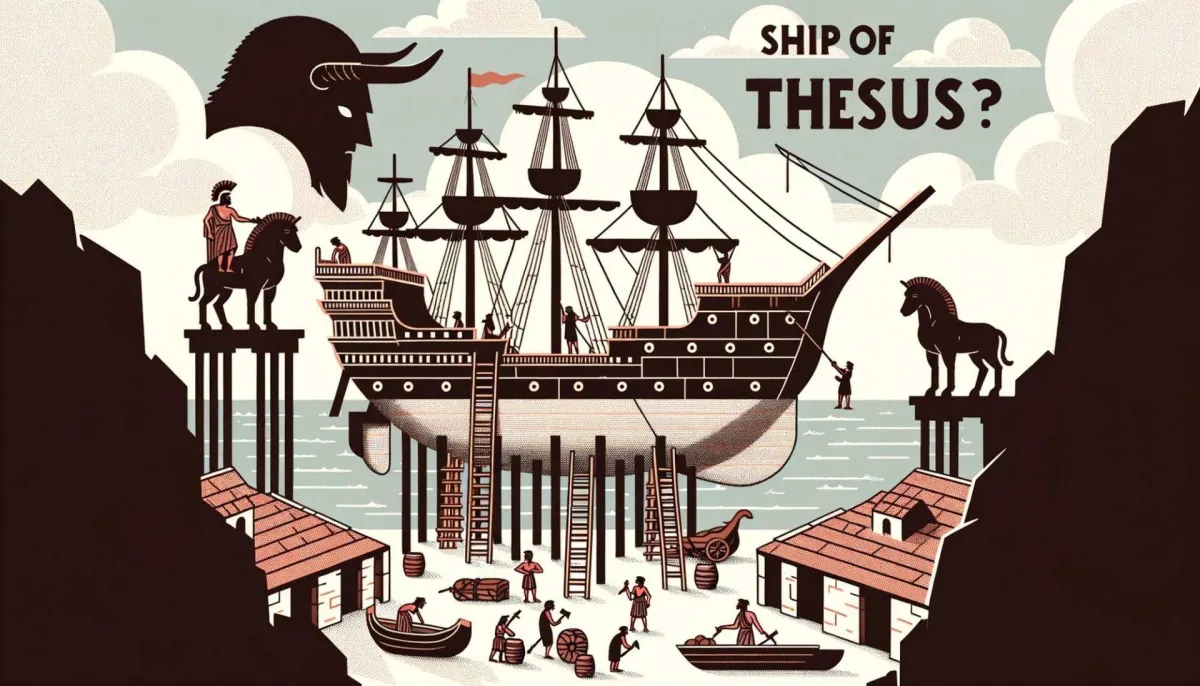 Photo: Ship of Theseus, via en.jotem.in
By the 1920s, the bridge had crossed a threshold that even the most generous interpretation of "original structure" couldn't accommodate. Contemporary engineering surveys conducted during a regional infrastructure audit found that the iron in place bore no serial markings matching the original fabrication records. The bridge was, in any physical sense, a completely different object than the one christened in 1872.
But no one had ever officially said so. And in the world of government recordkeeping, what isn't officially said often doesn't exist.
When Washington Had to Weigh In
The situation finally forced a federal response in the 1930s, when New Deal infrastructure programs required precise documentation of existing structures before new funding could be allocated. A Works Progress Administration surveyor reviewing regional bridge records flagged the Pennsylvania crossing as anomalous — a structure with a five-decade paper history that matched nothing in its physical inventory.
 Photo: Works Progress Administration, via f4.bcbits.com
What followed was genuinely unprecedented. Federal engineers, legal counsel from the Department of the Interior, and state officials spent the better part of two years working through a question that had never needed answering before: at what point does a repaired structure become a new structure?
The ruling they eventually produced — dry, bureaucratic, and almost entirely unread outside the offices that generated it — established what became a foundational principle in American infrastructure law. A structure retains its legal identity so long as the replacement of components occurs incrementally, is documented as maintenance rather than reconstruction, and does not involve a change in the structure's fundamental purpose or alignment. The moment any of those conditions breaks down, the structure must be reclassified.
The Pennsylvania bridge, under this framework, had technically ceased to be itself sometime around 1905. Everything certified after that point had been, in a legal sense, a fiction.
What the Town Did With the Answer
Locals, for their part, were not especially interested in the philosophical implications. The bridge was the bridge. It got you across the river. It had always gotten you across the river. The idea that it had been legally fictitious for thirty years struck most residents as exactly the kind of thing that happened when you let lawyers think too hard about bridges.
The county did eventually reclassify the structure and refile its documentation under a new construction date. The original 1872 record was annotated, not deleted — a small archival acknowledgment that something had once existed there, even if it was impossible to say precisely when it had stopped.
Why This Story Keeps Mattering
The ruling generated by this case didn't make headlines. It didn't need to. But it quietly shaped how American infrastructure agencies document, classify, and fund bridge maintenance to this day. Every time a highway department debates whether a repair qualifies as reconstruction, or whether a restored structure can keep its historical designation, the framework established by one quietly miscalculated Pennsylvania bridge is somewhere in the background.
The Ship of Theseus never had a federal case number. This one did. And somehow, that makes the paradox stranger, not simpler.