Home Is Where the Terminal Is: The Man Who Lived Inside an Airport for Nearly Two Decades
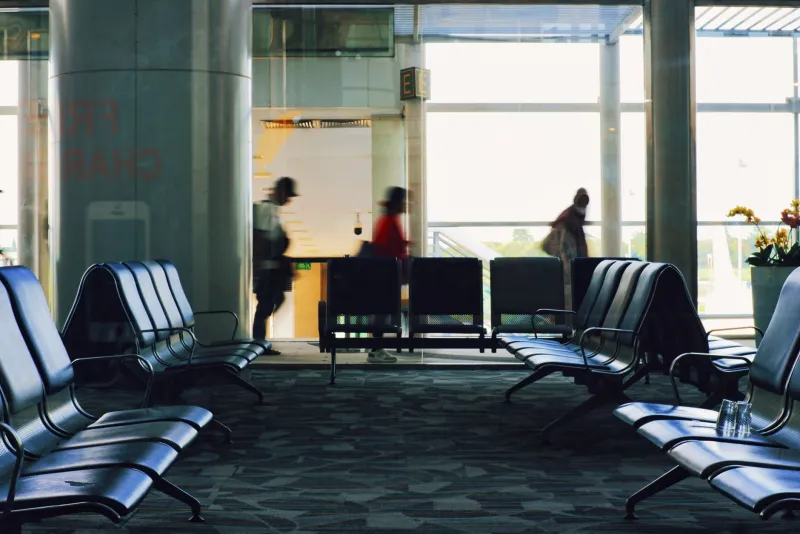
Most people treat airports like waiting rooms — temporary, uncomfortable, something to escape as quickly as possible. Mehran Karimi Nasseri treated one like a home address. Not by choice, exactly. But not entirely against his will either, by the end. His story sits somewhere in the strange overlap between bureaucratic nightmare, personal stubbornness, and the kind of accidental permanence that only real life can produce.
The Ticket That Went Nowhere
Nasseri was an Iranian refugee who had spent years bouncing between European countries trying to establish legal residency. In 1988, he arrived at Charles de Gaulle Airport outside Paris carrying a refugee document issued by Belgium. The problem: somewhere between London and Paris, his papers disappeared. Stolen, he believed. Gone, in any case.
Without those documents, French authorities couldn't process him for entry into France. Without entry into France, he couldn't legally leave the airport. Without leaving the airport, he couldn't travel to Belgium to replace the missing paperwork. And Belgium, for reasons that were never entirely clear, eventually stopped recognizing him as their problem at all.
He was, in the most literal sense, a man without a country — stranded in the international transit zone of Terminal 1, a stretch of airport that technically exists outside French legal jurisdiction. He hadn't entered France. He hadn't gone anywhere else. He simply... stayed.
Bench 51
Nasseri set up his life on a red plastic bench near a fast food counter in the departure lounge. He kept his belongings in a small cart. He read newspapers, wrote in journals, and followed a daily routine with the kind of discipline that would make a monk nod approvingly. Airport workers brought him food. Travelers gave him money. He read philosophy and wrote obsessively about his own situation, sometimes referring to himself in the third person as "Sir Alfred" — a name he had adopted from a story he told about his biological parents.
The French government, to their credit, did try to help. Lawyers filed paperwork. Humanitarian organizations got involved. At one point in 1992, a French court actually granted him the right to live and work in France — but Nasseri refused to sign the documents because they listed him under his Iranian name rather than "Sir Alfred." The legal resolution sat unsigned. He stayed on the bench.
By the late 1990s, he had become something of an airport celebrity. Journalists flew in specifically to interview him. Steven Spielberg's team reportedly paid him a reported $250,000 for the rights to his story, which became the 2004 Tom Hanks film The Terminal. The movie compressed his ordeal into something more digestible and gave it a tidy ending. Real life was considerably messier.
The Part Nobody Talks About
What the film glossed over was how deeply strange Nasseri's mental state had become by the time cameras started showing up. Years of institutional limbo had taken a toll. He was inconsistent about his own history, changing key details of his story depending on the day and the interviewer. He was suspicious of the very lawyers working to free him. He had, in a way that's hard to describe without sounding cruel, become the airport. It was the only stable thing in his life, and stability — even of the fluorescent-lit, recycled-air variety — becomes its own kind of comfort.
French authorities, for their part, largely left him alone. He wasn't causing trouble. He wasn't costing the government much. And nobody could quite figure out what legal mechanism would actually force him to leave a zone that technically wasn't French territory.
The Exit That Finally Came
In 2006, after eighteen years, Nasseri fell ill and was hospitalized. That medical intervention did what years of legal maneuvering couldn't: it physically removed him from the terminal. He was eventually placed in a shelter in Paris, where he lived quietly and largely out of public view for years.
Then, in November 2022, he returned to Charles de Gaulle Airport. Whether he was drawn back by habit, nostalgia, or something harder to name isn't entirely clear. He set up near his old spot in Terminal 2F. And within hours of arriving, he collapsed and died. He was in his late seventies.
The airport that had been his prison had also, in some sense, been the only place he ever really lived.
Why This One Sticks With You
Nasseri's story is often told as a bureaucratic horror story, and it is. The system failed him in ways that are almost comical in their redundancy — each authority pointing at another authority, each missing document creating the need for another missing document. But it's also something stranger than a simple institutional failure.
It's a story about how a person can adapt to almost any circumstance, given enough time. About how the line between captivity and chosen residence can blur until it disappears entirely. And about how the rules that are supposed to govern human movement can, under the right combination of circumstances, simply stop applying — not through rebellion or revolution, but through the quiet, persistent fact of a man sitting on a bench and refusing to be categorized.
There is no category for what Mehran Karimi Nasseri was. That, more than anything, is why nobody knew what to do with him.