Paid to Guard a Building That No Longer Existed: The Great Lakes Lighthouse Keeper Who Stayed on the Federal Payroll for Over a Decade After His Post Was Demolished
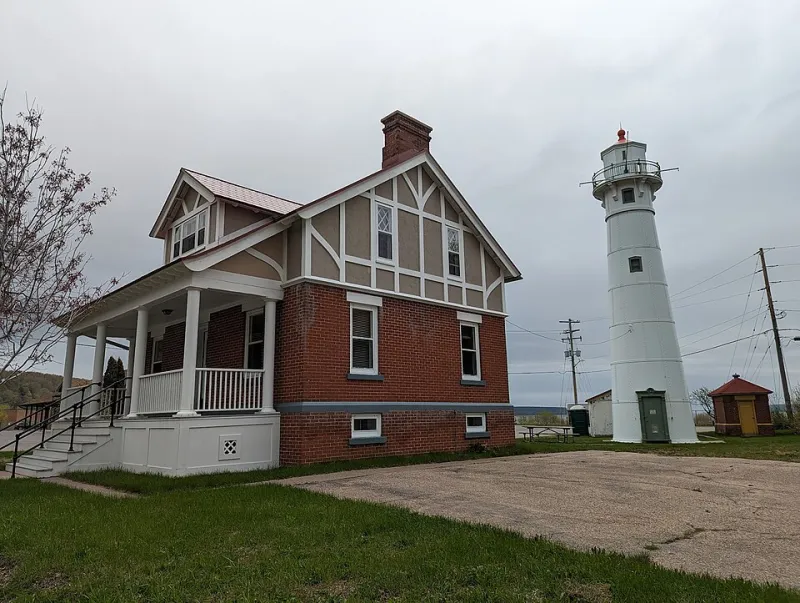
Photo: BakedintheHole, CC0, via Wikimedia Commons
The Last Assignment
In the fall of 1931, a U.S. government crew arrived at a modest Great Lakes lighthouse and began the methodical work of decommissioning it. The light was outdated, the structure had been superseded by more modern navigation equipment, and the federal budget — straining badly under the early weight of the Depression — had no patience for maintaining infrastructure that served no practical purpose.
 Photo: Great Lakes, via databayou.com
Within a few weeks, the lighthouse was gone. The site was cleared. The equipment was redistributed. And the keeper, a federal employee who had tended the light for years with the kind of quiet, unglamorous dedication the job required, received no formal notice of termination.
Not because anyone decided to keep him on. Because no one, in any of the overlapping agencies responsible for the situation, thought to file the paperwork that would have taken him off.
For the next eleven-plus years, the federal government paid a salary to a man employed to maintain a building that had been rubble since Hoover was president.
How the Bureaucracy Ate Itself
To understand how this happened, you have to understand the administrative landscape of federal lighthouse management in the early 1930s. It was not, to put it diplomatically, a model of streamlined governance.
The U.S. Lighthouse Service, the agency that had historically managed the nation's coastal and inland navigation lights, was in the middle of a prolonged institutional death spiral. Congress had already decided to fold its functions into the U.S. Coast Guard, a process that was supposed to be orderly and was not. Records were being transferred between agencies. Personnel files were moving from one office to another. And the whole transition was happening against the backdrop of an economic collapse that was consuming the government's attention at every level.
 Photo: U.S. Lighthouse Service, via upload.wikimedia.org
The lighthouse in question sat at the intersection of at least three different administrative jurisdictions — the Lighthouse Service, the Army Corps of Engineers, and a regional Coast Guard district — each of which had partial responsibility for its operation and none of which had clear sole authority over its personnel records. When the decommissioning order came through, the physical demolition was handled efficiently. The administrative side was not.
The order to remove the keeper from the payroll was generated by one office, routed to a second for approval, and appears to have arrived at a third office that had no record of the keeper's original employment. In the confusion of the agency merger, the termination paperwork simply stopped moving. And the salary payments, processed through a separate system that had no visibility into the demolition order, kept going.
What He Actually Did
This is the part of the story that tends to surprise people the most.
The keeper didn't hide. He didn't pretend the lighthouse still existed. He was, by all accounts, a straightforward and conscientious man who had spent his career doing an honest job in an isolated posting. When the lighthouse came down, he wrote to the regional office asking for his new assignment. He received no response. He wrote again. Still nothing.
So he waited. And the checks kept coming.
During those eleven years, he did what any reasonable person in his situation might do: he kept himself available, maintained the kind of general readiness his employment status seemed to require, and periodically attempted to get someone in the federal bureaucracy to tell him what he was supposed to be doing. The federal bureaucracy, occupied with a depression and then a world war, did not get back to him in any meaningful way.
There is something almost poignant about the image — a man trained to keep a light burning, sitting in a house near a stretch of Great Lakes shoreline, writing letters to offices that had lost his file, cashing government checks that arrived with the regularity of the tides he used to watch from a tower that no longer stood.
The Discovery and Its Complications
The situation came to light — so to speak — during a wartime audit of federal personnel expenditures in the early 1940s. Auditors reviewing Coast Guard payroll records flagged an anomaly: a salary being paid to a keeper assigned to a station that didn't appear in any current inventory of active lighthouses.
The investigation that followed was, by government standards, fairly swift. Within a few months, auditors had traced the payment history back to the 1931 decommissioning, identified the administrative breakdown that had allowed the salary to continue, and located the keeper, who was very much alive and apparently unsurprised that someone had finally noticed.
What came next was genuinely complicated. The government could not simply stop payment — there were legal processes governing the termination of federal employment, and the keeper had, in a technical sense, never been formally terminated from his original position. His employment was still active. He was still, on paper, a lighthouse keeper. The fact that the lighthouse was gone was, from a strictly administrative standpoint, not his problem.
Legal counsel for the relevant agencies spent several months working through the question of how to end employment at a job with no physical location, no duties, and no structure to report to. The keeper, to his credit, cooperated fully and expressed no particular interest in prolonging the situation. He just wanted someone to tell him, officially, that he could stop waiting for an assignment.
The Paperwork Finally Catches Up
The formal termination was processed in 1943, more than eleven years after the lighthouse had been demolished. The keeper received back pay clarification, a formal letter of separation, and — in a detail that feels almost too perfect — a commendation for his years of service to the Lighthouse Service, an agency that had itself been officially dissolved two years earlier.
The total cost to the federal government of the oversight was not enormous by wartime standards. But the case became a quiet landmark in federal personnel administration, cited in internal guidance documents as an example of what happens when overlapping jurisdictions and incomplete record transfers collide with a bureaucratic system that defaults to continuation rather than cessation.
The lighthouse is long gone. The keeper is long gone. But somewhere in the administrative history of the U.S. Coast Guard, there is a file documenting eleven years of salary paid to maintain a light that wasn't there — a small, strange monument to the particular genius of bureaucratic inertia.