The Dentist Who Named a Color That Scientists Had Been Ignoring for Centuries

Photo: color theory chart vintage art studio paint swatches, via i.etsystatic.com
The Problem With Color Nobody Wanted to Admit
Here is a strange thing about human beings: we have been making, trading, and arguing about color for thousands of years, and for most of that time, we had no reliable way to describe it.
A painter in 1890 who wanted to match a specific shade of blue-green had two options. She could hold a swatch next to her canvas and squint. Or she could use a name — teal, perhaps, or turquoise, or seafoam — and hope that whoever she was talking to had the same color in mind. Usually, they didn't. Color names were impressionistic. They drifted between speakers, between regions, between industries. Dye manufacturers and printers and fabric merchants had all developed their own internal systems, none of which talked to each other.
This was the gap that Albert Munsell walked into, largely by accident, at the turn of the twentieth century.
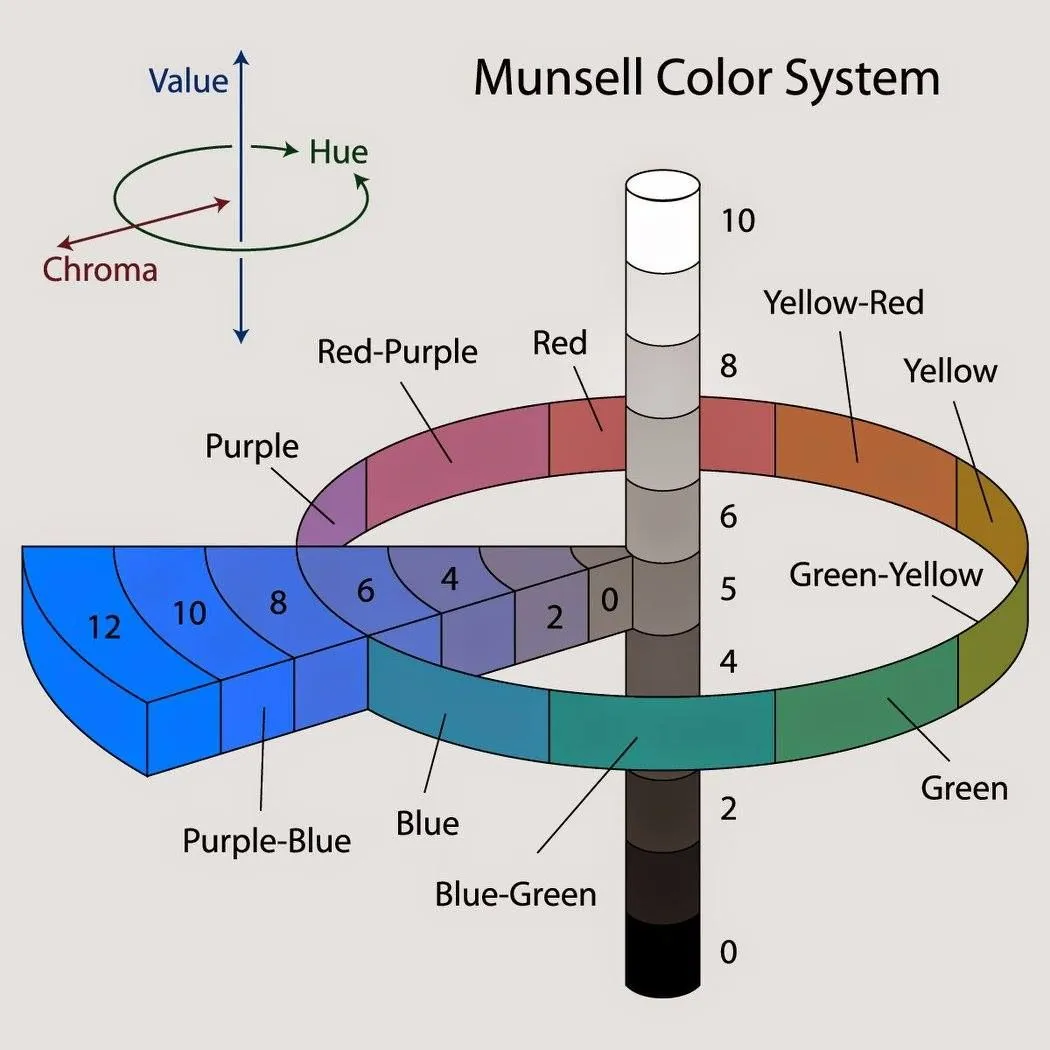 Photo: Albert Munsell, via i.pinimg.com
An Unusual Resume
Munsell was not a chemist or a physicist. He was a Boston art teacher who had studied painting in Paris and developed, somewhere along the way, an almost clinical interest in the mechanics of visual perception. He was also, in at least some accounts of his career, a practicing dentist — a detail that tends to stop people when they first encounter it, because it is difficult to imagine a single professional identity that seems less connected to color theory.
But Munsell's outsider status was arguably his greatest asset. He approached color the way a person approaches a problem they've never been told is unsolvable. He wasn't working within an established framework, so he wasn't constrained by one.
Starting in the 1890s and continuing into the early 1900s, Munsell developed a three-dimensional system for classifying color based on three independent variables: hue (the basic color family), value (how light or dark), and chroma (how saturated or vivid). He built physical models. He created charts. He spent years refining measurements that he believed could make color description as precise and transferable as a musical note.
The system was rigorous in a way that existing color vocabulary simply wasn't. And in building it, Munsell kept running into the same strange problem.
The Color That Had No Name
As Munsell mapped the relationships between hues, he found a consistent gap in the existing vocabulary — a region of the color space sitting between what people called blue-green and what people called green-blue, distinct enough to influence perception but never formally acknowledged as its own category.
Painters had been navigating around it for generations. Printers had developed workarounds. Dye manufacturers had approximate internal labels. But no one had formally named it or precisely defined its boundaries. It existed in practice everywhere and in language nowhere.
Munsell named it. He documented it with the same methodical precision he applied to the rest of his system, placing it within his three-dimensional color space with specific coordinates that made it reproducible — meaning that for the first time, two people in different cities could refer to this particular hue and be certain they were talking about the same thing.
The scientific community's reaction was underwhelming.
The Long Fight to Be Taken Seriously
Munsell published his system in 1905 in a book called A Color Notation. It was well-made, carefully argued, and almost entirely ignored by the scientific establishment.
Part of the problem was professional gatekeeping. Munsell wasn't a credentialed scientist. He was an art teacher who had wandered into a field that physicists and chemists considered their territory, and he had arrived with a system built around perception rather than wavelength. The academic color scientists of the era were focused on the physics of light. They weren't particularly interested in how a dentist-painter thought colors should be organized for human use.
Munsell spent years lobbying, demonstrating, and corresponding with anyone who would engage with his ideas. He found allies in art education — his system was genuinely useful for teaching, and schools began adopting it — but recognition from the scientific community came slowly and partially.
He died in 1918, before the full vindication arrived.
What Happened After
In 1943, the Optical Society of America conducted a comprehensive review of the Munsell system and essentially confirmed what Munsell had been arguing for decades. The system was formally adopted as a standard reference framework, and the color coordinates he had documented — including the previously unnamed hue — became part of the official scientific record.
The color still carries his name in the notation system that professionals use today. Graphic designers, paint manufacturers, textile companies, and forensic analysts all work with Munsell references. The unnamed hue he identified now has a precise address in color space that anyone in any country can locate and reproduce.
Why an Outsider Saw What the Experts Missed
The most interesting question the Munsell story raises isn't about color at all. It's about why a trained dentist and art teacher spotted something that professional scientists had overlooked for centuries.
The answer is probably that the experts were looking in the wrong direction. Physicists studying color were interested in light waves and prisms. They weren't thinking about human perception and communication. Munsell was thinking about almost nothing else.
Sometimes the gap is invisible to the people standing inside the field. It takes someone approaching from a strange angle — someone who wasn't told the gap didn't exist — to see it clearly.
Munsell saw it. He named it. And a century later, every time a paint company matches a color to a standard reference, they're using a system built by a man whose professional colleagues mostly thought he should stick to teeth.