He Read the Blueprints Backwards and Built Bridges That Refused to Fall Down
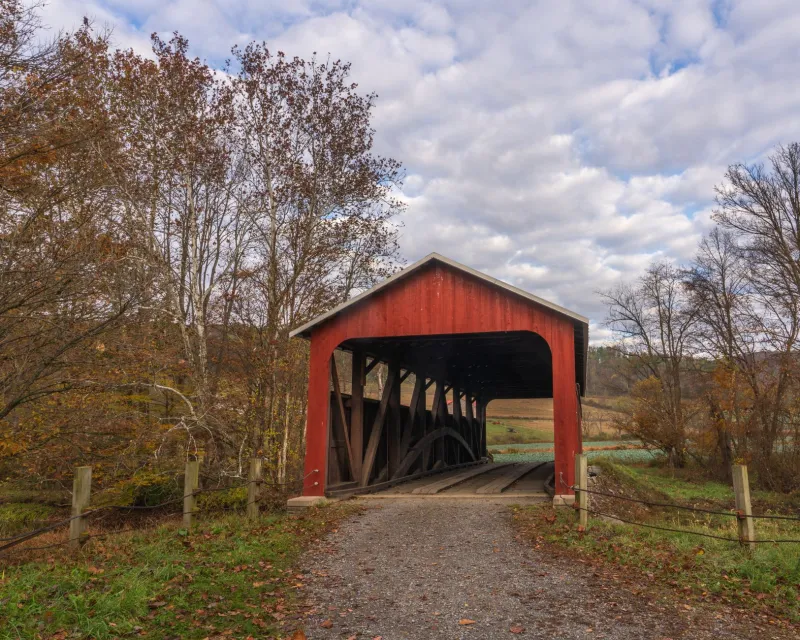
There's a bridge in rural Pennsylvania that engineers visit like pilgrims. Not because it's beautiful — it isn't, particularly. Not because it's famous — most people drive over it without a second thought. They come because it shouldn't still be there. By every standard calculation developed over the past century of structural engineering, this bridge should have needed major rehabilitation decades ago. Instead, it just keeps going.
The man who built it processed blueprints in a way that his supervisors once described, with considerable frustration, as "mirror logic."
The Engineer Nobody Could Quite Explain
Clarence Mott worked for a regional infrastructure firm in western Pennsylvania from the late 1940s through the mid-1970s. He was, by most accounts, an exceptionally capable engineer — methodical, precise, and deeply committed to his work. He was also severely dyslexic at a time when the condition was poorly understood and rarely accommodated. In practice, this meant that Mott often interpreted load distribution diagrams and stress calculations in ways that were spatially inverted from standard convention.
His colleagues caught the discrepancies regularly and corrected them. What nobody fully appreciated until much later was that Mott had developed his own internal system for compensating — one that sometimes overcorrected in ways that produced structural decisions nobody else would have made deliberately.
The results looked, on paper, like mistakes. Tension members placed where compression members were expected. Load paths that seemed to take the long way around. Redundant supports where the math said none were needed. His supervisors signed off on the final drawings, having reviewed and "fixed" what they could catch, but Mott's underlying logic had a way of surviving the editing process.
What the Decades Revealed
For a long time, nobody connected the dots. Mott's bridges were built, inspected, and filed away like any others. The engineering firm he worked for closed in the 1980s. His personal records were largely lost.
The thread was picked up almost by accident in the early 2000s, when a structural engineer named Patricia Deane was conducting routine assessments of aging infrastructure across several Pennsylvania counties. She noticed something statistically strange: a cluster of bridges built between 1951 and 1973 were outperforming every predictive model she applied. They weren't just holding up — they were holding up better than bridges built more recently with superior materials and updated design codes.
Deane started pulling construction records. The common thread was Mott.
"At first I thought it was a data error," she later told a regional engineering journal. "Then I thought it was a materials fluke. Then I actually looked at the designs."
The Accidental Innovation
What Mott had done, researchers eventually concluded, was inadvertently incorporate principles that structural engineers wouldn't formally theorize about until the 1990s — specifically, concepts related to load redistribution and what's now called "structural redundancy optimization."
In simplified terms: conventional mid-century bridge design was efficient. It directed stress loads along the most direct, mathematically elegant paths. Mott's designs, shaped by his unconventional reading of stress diagrams, spread those loads across more of the structure — creating redundant pathways that weren't strictly necessary under normal conditions but became critically valuable under stress, fatigue, and the kind of long-term material degradation that engineers of his era weren't fully modeling.
His bridges didn't just carry load. They shared it, in ways that turned out to be remarkably forgiving of wear.
The irony is exquisite: the "corrections" his supervisors applied to his work actually reduced some of this effect. The bridges where Mott's original logic survived most intact are, in several documented cases, the ones still standing in the best condition.
The Harder Question
Researchers studying Mott's work have been careful not to over-romanticize the story. Not everything he built was exceptional. Some of his structures required early intervention. His methods were inconsistent, shaped by a condition he was managing without support in an era that offered him none.
But the broader implication is genuinely uncomfortable for a field that prizes mathematical precision above almost everything else: a man who processed structural information differently from his peers stumbled into design principles that the field hadn't yet articulated — and the structures he produced outlasted the consensus wisdom of his time.
Modern engineers studying his work have used it to inform updated thinking about redundancy in bridge design. His name appears in at least two academic papers, neither of which he ever knew about. He died in 1989.
Still Standing
The Pennsylvania bridge that draws engineering visitors sits over a creek that floods badly most springs. It has handled decades of heavier-than-designed truck traffic as agricultural equipment got larger. It has never been closed for structural concerns.
A conventional bridge built fifteen miles away in the same year, by the same firm, following standard practice, was replaced in 1998.
Sometimes the quirk in the system is the system working. It just takes a while to figure out which is which.