Elections Were Held, Nobody Showed Up: The Town That Governed Itself Into Oblivion
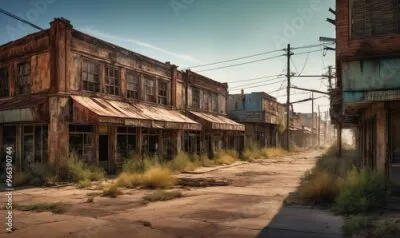
Photo: abandoned american ghost town main street empty buildings, via img.myloview.com
Every town in America has a story. Very few have a punchline like this one: the government stayed open for business, but nobody was left to govern.
It sounds like a joke a county clerk tells at parties, but it's a real administrative phenomenon that's played out across the American Midwest and West. When the last resident of a small incorporated town packs up — usually after a mine closes, a highway reroutes, or a railroad decides the depot is no longer worth the stop — the town itself doesn't vanish. The incorporation doesn't expire. Legally speaking, the municipality lives on, complete with a mayor, sometimes a council, and a set of ordinances that now apply exclusively to prairie dogs and passing weather.
Paperwork Is Immortal
Here's the thing most people never think about: dissolution is an active process. A town doesn't die just because its people do. Someone has to file the paperwork, hold the final vote, settle the debts, and convince the state to strike the municipality from the rolls. If the last handful of residents can't or won't do that — because they're elderly, because the town owes money, because nobody can agree — the ghost town keeps its legal heartbeat.
In several documented cases, this meant the town technically continued to hold elections. Polls would open. Notices would be posted, as the law required, on the community bulletin board or the door of the abandoned grange hall. And then they'd close, with zero ballots cast, and the results would be certified anyway. The incumbent mayor of one such town was re-elected repeatedly by an electorate of nobody, because under state law, if no one filed to run against him, he simply retained the office. He was, in the most literal sense possible, the mayor of nothing.
Who Pays for Streetlights Nobody Sees?
The absurdity compounds when you follow the money. An incorporated town can still hold tax liens, still owe on municipal bonds, still be responsible for a water system serving zero taps. Counties have discovered that they couldn't just absorb a dead town's roads or liabilities — they had to wait for the municipality itself to formally dissolve, which required either residents (there were none) or a court order (which required someone motivated enough to file one).
In one widely reported case, the situation lingered for decades. The town's officials — some of whom had moved counties away — remained on the books, technically in office, technically empowered to call meetings nobody could attend. State auditors flagged it. County attorneys shrugged. And the town floated there, a legal phantom with a name on state maps and a budget line in obscure ledgers.
The Funeral for a Zip Code
Eventually, in most of these cases, someone does the unglamorous work. A county clerk, a state legislator, or a stubborn local historian decides the farce has gone on long enough and shepherds a dissolution bill through the process. There's something genuinely poignant about these final acts: a last official meeting, held perhaps in a county office rather than a town hall, minutes recorded by someone who never saw the town alive. The ledger closes. The incorporation is repealed. A place that held on for years after its people left finally gets to stop pretending.
It's easy to laugh at the image of a mayor governing an empty grid of streets. But there's a stranger truth underneath: American law simply has no mechanism for a town to die quietly. Communities are creatures of paperwork, and paperwork, unlike people, never gets tired, never moves away, and never stops expecting a quorum.
Somewhere out there, on a dusty stretch of state highway, there may still be a sign welcoming you to a town with a functioning government and a population you could count on one hand with fingers to spare. If the lights are on, nobody's home — but the mayor, technically, still is.