The Depot That Couldn't Decide What Time It Was: A Railroad Mistake That Haunted an Entire County for Eighty Years
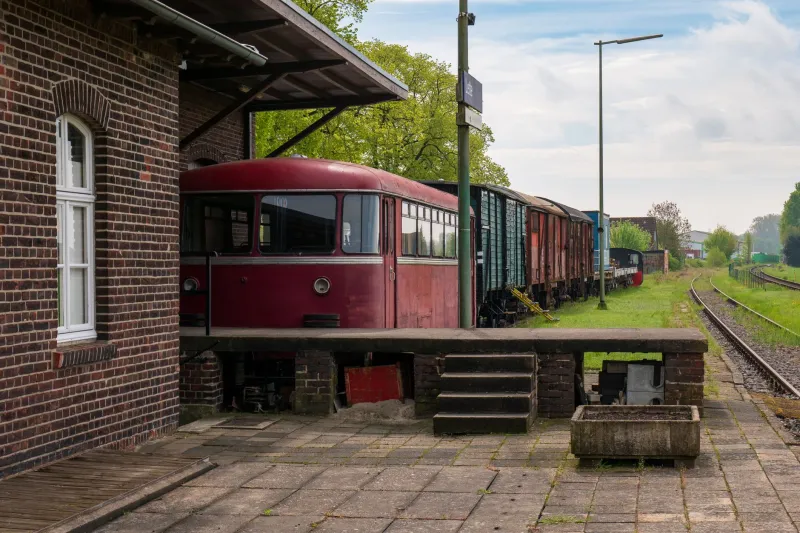
Time zones, when you think about them too hard, start to feel a little arbitrary. They're lines we drew on maps to make trains run on schedule. But what happens when the train station itself ends up on the wrong side of one of those lines? In a small corner of rural Indiana, that question wasn't hypothetical. It was a daily operational problem that persisted for the better part of a century.
The story begins around 1906, though the exact date is disputed — which is fitting, given what the story is about.
A Depot Built Forty Feet From Sanity
The town of Millhaven — a name that has been changed here, though the real community is a matter of county record — was a modest agricultural stop on a regional rail line pushing through west-central Indiana. The railroad company contracted a local crew to build a small depot to serve the town, and by most accounts the crew did a competent job. The building went up on schedule, the platform was level, and the waiting room had a proper stove.
The problem was the survey.
The county line between the two jurisdictions ran through that stretch of land in a way that wasn't obvious on the ground. There was no river, no ridge, no visible marker — just a legal boundary that existed primarily on paper and in the records of two county courthouses. When the crew staked out the depot location, they used reference points from a map that had a small but consequential error. The finished building sat approximately forty feet east of where it was intended to sit.
Those forty feet placed the depot squarely inside the neighboring county.
At the time, this was mildly embarrassing and mostly irrelevant. The town was right there. The passengers were right there. Trains would stop, people would board, life would continue. Nobody filed a formal complaint, and the railroad company — with the particular priorities of railroad companies in 1906 — was not interested in tearing down a perfectly functional building over a surveying footnote.
The Clock Problem Nobody Saw Coming
The issue might have stayed dormant forever if not for one specific detail of early twentieth-century American life: Indiana's relationship with time was already complicated.
For reasons rooted in geography, agriculture, and a stubborn local resistance to outside scheduling, different parts of Indiana operated on different time standards for much of the 1900s. Counties near the Illinois border tended to observe Central time. Counties oriented toward Ohio and the eastern rail corridors often ran on Eastern time. The state wouldn't fully resolve this until 2006, when it finally adopted uniform observance of Eastern Daylight Time — a decision that was itself controversial enough to generate genuine political heat.
Millhaven's county observed one standard. The neighboring county, where the depot actually sat, observed another. The difference was one hour.
Suddenly, those forty feet mattered enormously.
Two Clocks, One Wall, Zero Agreement
Railroad schedules are not suggestions. Trains arrive and depart at specific times, and those times are coordinated across a network that doesn't accommodate local ambiguity well. The regional rail line published its timetables according to the time standard of the county where each depot was officially registered — which, for Millhaven's depot, meant the neighboring county's clock.
This created a situation that locals described, in various surviving letters and newspaper items from the period, as somewhere between confusing and maddening. A farmer driving his wagon from town to catch the morning train had to mentally calculate which clock applied. The depot's posted schedule reflected one time. The town's church bells rang on another. Travelers who didn't know the local quirk missed trains. Travelers who did know sometimes overcorrected and arrived an hour early.
At some point in the 1920s, a depot agent solved the problem the way pragmatic people have always solved impossible bureaucratic problems: he hung two clocks. One was labeled for the depot's official jurisdiction. One was labeled for the town. Both kept accurate time. Neither was wrong. Together, they were a daily reminder that the building existed in a kind of temporal no-man's-land.
Photographs from the 1940s show both clocks still on the wall, side by side above the ticket window.
The Argument That Lasted Longer Than the Trains
Passenger rail service through Millhaven declined through the 1950s and essentially ended by the mid-1960s, which you might expect would also end the time zone problem. It didn't, because by then the depot had been repurposed as a freight handling facility, and the jurisdictional question had taken on new dimensions involving tax assessment, road maintenance responsibility, and the perennial question of which county was supposed to plow the access road in winter.
County officials on both sides of the line spent decades in a state of low-grade disagreement about the depot's status. Neither county particularly wanted to absorb the administrative complexity of a building that served a town in the other jurisdiction. Both counties had, at various points, quietly declined to include the depot in their official infrastructure inventories.
Regional planners finally addressed the matter formally in 1987, when a state-level infrastructure review forced both counties to resolve their overlapping and contradictory records. The solution was elegantly simple and arrived about eighty years late: the county line was redrawn by a small adjustment that placed the depot back in Millhaven's county, where it had always functionally belonged.
The building was demolished in 1993. The two clocks, according to one account, went to a local historical society. Whether they're still keeping time is unknown.
What a Forty-Foot Error Teaches Us
It would be easy to frame this as a story about incompetence — a crew that couldn't read a map, a railroad company that wouldn't fix a mistake. But the more interesting reading is about how systems designed for order can produce sustained disorder when they bump into each other at the edges.
Time zones exist to make coordination possible. County lines exist to make governance possible. Neither system anticipated a building that sat in the gap between them. And once the gap existed, the machinery on both sides just kept running — scheduling trains, assessing taxes, plowing roads — in ways that quietly acknowledged the problem without ever quite solving it.
For eighty years, a small Indiana depot asked a simple question every morning: what time is it? And for eighty years, the honest answer was: it depends on which clock you're looking at.