When Democracy Gets Personal
In 1897, the railroad town of Harmony Springs, Montana, found itself in an unusual predicament. The county sheriff had resigned, the circuit judge had moved to California, and the nearest courthouse was a three-day ride away across increasingly treacherous mountain passes. Rather than petition for new officials or relocate entirely, the 247 residents of Harmony Springs made a decision that would define their community for the next quarter-century: they would govern themselves.
Not through elected representatives or formal democratic processes, but through something far more radical—complete reliance on community consensus and personal honor. No laws, no courts, no police. Just neighbors talking to neighbors until problems got solved.
The Handshake Constitution
The system that emerged was elegantly simple. Disputes were resolved through community meetings held every Sunday after church service in the town's only large building, the grain storage warehouse. Anyone could bring up a problem, anyone could propose a solution, and discussion continued until everyone agreed—or at least until everyone could live with the outcome.
"We didn't vote on things the way other places did," recalled Martha Hendricks in a 1962 interview, one of the last surviving residents from Harmony Springs' experimental period. "Voting meant some folks won and others lost, and we all had to keep living together. We talked until we found something everyone could accept."
The community developed informal protocols that seem almost impossibly idealistic in retrospect. Property disputes were resolved by having the disagreeing parties walk the contested boundaries together with three neutral neighbors until they reached an agreement. Business disagreements were settled by having the merchants involved present their cases to their customers, who would then suggest compromises.
Even criminal matters—the few that occurred—were handled through community discussion. When young Tom Mitchell was caught stealing tools from the blacksmith shop in 1903, the community meeting resulted in Mitchell working for the blacksmith for six months without pay while learning the trade. Mitchell eventually became the town's second blacksmith and, by all accounts, never stole anything again.
The Surprising Success
For nearly two and a half decades, Harmony Springs' honor system worked with remarkable effectiveness. The town maintained detailed records of community decisions, and the statistics are genuinely surprising. Between 1897 and 1922, only seven disputes required more than two community meetings to resolve. No resident was ever seriously injured in a conflict with another resident. Property theft was virtually nonexistent after the Mitchell incident.
More remarkably, the town thrived economically. Without the overhead costs of law enforcement, courts, or municipal government, Harmony Springs managed to build better roads, a more reliable water system, and superior schools than most comparable towns in the region. Visiting merchants frequently commented on the unusual cooperativeness of local business practices.
"Nobody tried to cheat anybody because they knew they'd have to face the whole community about it," explained Dr. James Morrison, a traveling physician who made regular stops in Harmony Springs during the period. "It wasn't fear of punishment that kept people honest—it was the knowledge that your reputation was everything in a place where everyone knew everyone."
The Social Pressure Mechanism
The system's success relied on what modern sociologists would recognize as intense social capital and community cohesion. In a town where everyone's livelihood depended on cooperation—from shared harvesting efforts to collaborative snow removal—social ostracism was a powerful deterrent to antisocial behavior.
But the system also created unique pressures. Residents couldn't simply avoid people they disliked or disagree with—they had to find ways to coexist productively. This forced a level of conflict resolution and interpersonal skill development that was unusual even for small rural communities of the era.
"You learned to separate the person from the problem," Hendricks remembered. "You might think someone's idea was terrible, but you couldn't just dismiss them because you'd need their help fixing your roof next month."
The Fence That Ended Everything
The honor system's downfall came not from crime or chaos, but from something far more mundane: a property line dispute that exposed the limitations of consensus-based governance. In the spring of 1922, two neighboring families—the Kowalskis and the Brennans—disagreed about the exact location of their shared fence line.
Under normal circumstances, this would have been resolved through the usual community process. But this particular dispute involved a strip of land that contained the town's only reliable water source during dry seasons. Both families had legitimate claims based on different surveys conducted years apart, and neither was willing to compromise on something so essential to their survival.
The weekly community meetings stretched into months of heated discussion. Neighbors took sides. The social fabric that had held the community together for twenty-five years began to fray as people found themselves forced to choose between the Kowalskis and the Brennans.
When Consensus Breaks Down
By late 1922, Harmony Springs was essentially split into two camps. Business relationships soured. Children were forbidden to play with children from the "wrong" families. The collaborative spirit that had made the honor system possible dissolved into bitter factionalism.
"It was like watching a family tear itself apart," recalled Robert Chen, whose grandfather owned the general store during the crisis. "People who had worked together for decades couldn't stand to be in the same room."
Faced with the complete breakdown of their social experiment, the community made a reluctant decision: they petitioned the county for formal law enforcement and judicial services. By 1923, Harmony Springs had its first sheriff in twenty-six years, and the fence dispute was resolved through traditional legal proceedings.
The Brennans won the case, but the victory felt hollow. The community that had prided itself on solving problems through cooperation had ultimately been defeated by the very human tendency to dig in and refuse to budge on matters of principle.
The Lessons of Harmony Springs
The story of Harmony Springs offers a fascinating glimpse into the possibilities and limitations of informal governance. For a quarter-century, a community proved that formal law enforcement wasn't always necessary for maintaining order and resolving conflicts. But it also demonstrated that consensus-based systems are only as strong as the community's willingness to prioritize collective harmony over individual interests.
Modern researchers studying the Harmony Springs experiment have identified several factors that contributed to its success: geographic isolation that created interdependence, economic conditions that required cooperation, and a relatively homogeneous population that shared basic values and assumptions.
They've also noted that the system's collapse was probably inevitable. As the town grew and became more connected to the outside world, the social pressures that had maintained order became less effective, and the community's ability to reach consensus on difficult issues eroded.
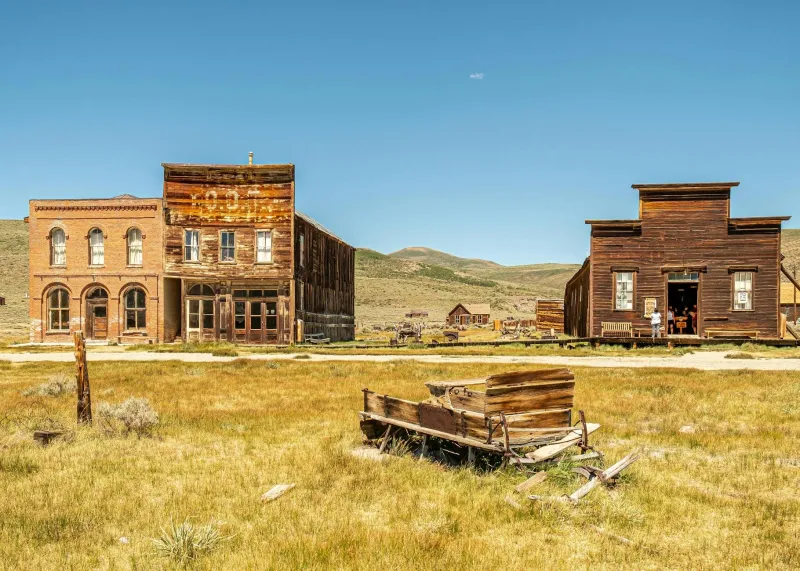
Today, the site of Harmony Springs is largely abandoned, marked only by a few foundation stones and a historical marker that briefly mentions the town's "unique period of self-governance." But the experiment remains a remarkable example of what's possible when a community decides to trust in its members' better angels—and a sobering reminder that even the most idealistic social experiments can be undone by something as simple as an argument over a fence.