When Purple Became Property
In the summer of 1995, the U.S. District Court for the Northern District of California faced a question that seemed better suited for a philosophy classroom than a federal courthouse: Can a company own a color?
The case began when Qualcomm, the telecommunications giant, filed a lawsuit against three smaller competitors, claiming they were illegally using Qualcomm's trademarked shade of purple in their corporate branding. Not purple in general — just one very specific shade that Qualcomm's legal team had registered as "Qualcomm Purple" under federal trademark law.
The defendants argued that the entire concept was absurd. "You can't own a color that occurs in nature," their lead attorney, Sarah Martinez, argued during opening statements. "What's next? Trademarking the blue of the sky?"
But Qualcomm's legal team had done their homework. They presented Judge Patricia Williams with a 200-page brief documenting how their specific shade of purple — defined by precise RGB values of 108, 42, 132 — had become synonymous with their brand in the telecommunications industry.
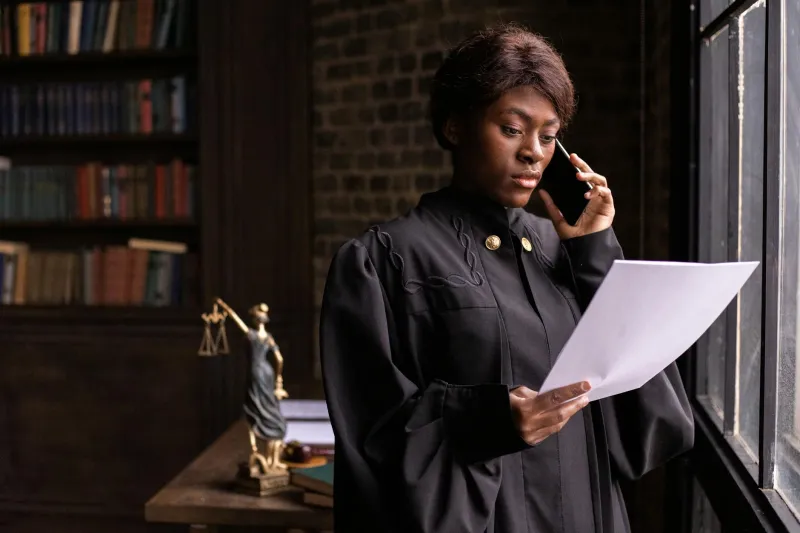
 Photo: Judge Patricia Williams, via www.law.columbia.edu
"This isn't about owning purple," Qualcomm's attorney explained. "This is about protecting the specific visual identity that our company has invested millions of dollars to establish."
The Science of Seeing Purple
What followed was perhaps the strangest expert witness testimony in federal court history. Judge Williams had to listen to three days of testimony about the physics of light, the biology of human vision, and the psychology of color perception before she could even begin to understand what, exactly, the two sides were arguing about.
Dr. Robert Chen, a color scientist from MIT, explained that what humans perceive as "purple" doesn't actually exist as a single wavelength of light. "Purple is a neurological interpretation," Chen testified. "It's what our brains create when they process a mixture of red and blue wavelengths simultaneously."
This revelation led to an extraordinary moment when Judge Williams asked, "So are we arguing about something that doesn't technically exist?"
"That's correct, Your Honor," Chen replied. "Purple is essentially a hallucination that all humans share."
The courtroom fell silent as everyone processed the implications: they were arguing about the legal ownership of a shared hallucination.
The Pantone Problem
The case became even more complex when both sides began citing the Pantone Color Matching System, the industry standard for defining specific colors. Qualcomm claimed their purple was "Pantone 2685 C," but the defendants argued that Pantone colors were descriptive, not proprietary.
This led to a surreal afternoon when Judge Williams had to examine dozens of color swatches under different lighting conditions to determine whether the defendants' purple was "substantially similar" to Qualcomm's trademarked shade.
"I never thought I'd be spending my Tuesday afternoon debating whether two pieces of purple paper look the same," Judge Williams remarked, holding up competing color samples. "But here we are."
The lighting question proved crucial. Under fluorescent courtroom lights, the colors appeared nearly identical. Under natural sunlight streaming through the courthouse windows, they looked distinctly different. Under the warm incandescent lighting that Qualcomm used in their showrooms, the similarity was somewhere in between.
"So the validity of this trademark depends on what kind of lightbulb we're using?" Judge Williams asked.
"Essentially, yes," replied Dr. Chen.
The Cultural Context Crisis
The case took another unexpected turn when the defendants brought in Dr. Lisa Park, an anthropologist specializing in color perception across cultures. Park testified that different cultures don't even categorize colors the same way, making the entire concept of "owning" a specific shade legally problematic.
"In some languages, what English speakers call 'purple' and 'blue' are considered the same color," Park explained. "If this court rules that Qualcomm owns this specific purple, are we inadvertently ruling that they also own blue in those cultural contexts?"
Judge Williams later described this moment as when she realized the case had implications far beyond corporate trademark law. "We weren't just deciding whether one company could own a color," she wrote in her final ruling. "We were potentially defining how human perception itself could be commodified."
The Precedent That Changed Everything
After six weeks of testimony that included color scientists, neurologists, anthropologists, marketing experts, and even a philosopher specializing in the metaphysics of perception, Judge Williams issued her ruling.
She found in favor of Qualcomm, but with significant limitations. The company could indeed own their specific shade of purple, but only within the telecommunications industry and only under specific lighting conditions. More importantly, Williams established strict guidelines for future color trademark cases.
"A color can be trademarked," Williams wrote, "but only when it has acquired 'secondary meaning' in a specific industry context and only when that meaning can be precisely defined using objective scientific measurements."
The ruling opened the floodgates. Within five years, companies had successfully trademarked dozens of colors: UPS's brown, Tiffany's blue, John Deere's green, and T-Mobile's magenta among them.
The Unintended Consequences
The Qualcomm decision had effects nobody anticipated. Graphic designers found themselves consulting trademark databases before choosing color schemes. Smaller companies discovered that certain color combinations were off-limits, forcing them to hire legal experts just to pick their branding colors.
The most bizarre consequence emerged in the fashion industry, where designers began creating "trademark-safe" color palettes that avoided any shades owned by major corporations. Fashion Week runway shows started featuring disclaimers about color usage rights.
"We created a world where you need a lawyer to choose what color to paint your logo," Martinez, the defense attorney, reflected years later. "I'm not sure that's the world anyone intended to create."
The Philosophy of Purple
Dr. James Morrison, the philosopher who testified as an expert witness, later wrote that the case represented a fundamental shift in how society thinks about ownership. "We moved from owning physical objects to owning experiences and perceptions," Morrison explained. "The Qualcomm case was the moment when human consciousness itself became a commodity."
The case also raised questions about the limits of intellectual property law. If companies could own colors, what about sounds? Smells? Textures? Each of these questions would eventually reach federal courts, with judges citing the Qualcomm precedent.
The Color-Coded Future
Today, the U.S. Patent and Trademark Office maintains a database of over 300 trademarked colors, each defined by precise scientific measurements and specific industry applications. The database includes detailed specifications for lighting conditions, material applications, and cultural contexts where each trademark applies.
Qualcomm still owns their specific shade of purple, now officially known in legal documents as "Qualcomm Purple (RGB 108, 42, 132) under fluorescent lighting conditions in telecommunications industry applications." The company estimates that protecting this trademark has been worth over $50 million in brand value.
Judge Williams, who retired in 2010, keeps a collection of purple color swatches from the case in her home office. "People ask me about the most interesting case I ever heard," she says. "I tell them it was the one where I had to decide whether a hallucination could be property."
The Lasting Questions
The Qualcomm case established that colors could be owned, but it also raised questions that courts are still grappling with today. As virtual reality and augmented reality technologies advance, new cases are emerging about who owns specific visual experiences and whether digital colors are subject to the same trademark protections as physical ones.
Sometimes the most important legal precedents come from cases that seem almost absurd on their surface. The day a federal court decided that a company could own purple, it fundamentally changed how we think about the relationship between perception, property, and the law.
And somewhere in a filing cabinet in California, there's still a folder full of purple color swatches that legally defined the boundaries of human perception under federal trademark law.