The Concrete Battleship That Shouldn't Have Floated But Dominated the Atlantic Anyway
The Desperate Gamble That Defied Physics
In 1918, the United States faced a shipbuilding crisis that threatened to lose World War I before American forces could make a difference. German U-boats were sinking Allied vessels faster than traditional steel shipyards could replace them, and the military faced an impossible choice: find a new way to build ships, or watch the war effort collapse from lack of transportation.
The solution came from an unlikely source: concrete. The same material used to build sidewalks and foundations was about to become the backbone of an experimental fleet that would challenge everything naval engineers thought they knew about maritime physics.
When Desperation Meets Innovation
The Emergency Fleet Corporation, tasked with solving America's shipping shortage, was running out of options. Steel was being rationed for weapons and ammunition, leaving shipbuilders scrambling for alternatives. Concrete seemed like the worst possible choice—heavy, brittle, and completely contrary to every principle of naval architecture.
But concrete had one overwhelming advantage: America had unlimited supplies of it. The raw materials were cheap, abundant, and didn't compete with military priorities. If concrete ships could somehow work, the US could build vessels faster than Germany could sink them.
The Emergency Fleet Corporation commissioned a radical experiment: twelve concrete cargo ships, each designed to carry 7,500 tons of supplies across the Atlantic. The lead vessel, christened SS Atlantus, would serve as a proof of concept for what everyone assumed would be a spectacular failure.
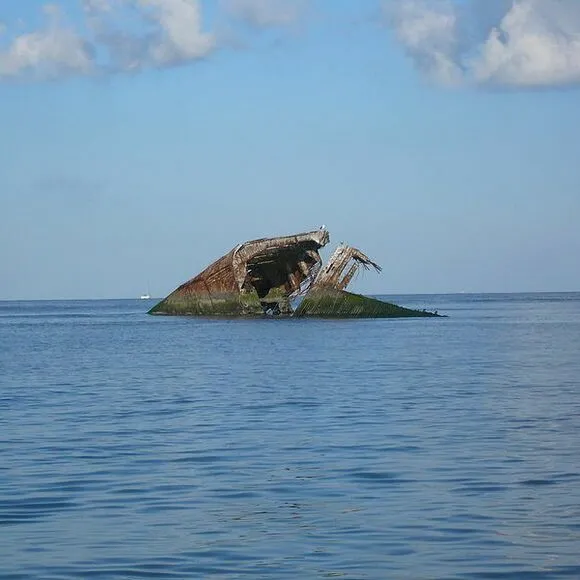 Photo: SS Atlantus, via i.pinimg.com
The Engineering Challenge Nobody Wanted
Designing a concrete ship required throwing out a century of naval architecture and starting from scratch. Traditional ships relied on steel's flexibility to handle the stresses of ocean waves, but concrete couldn't bend without breaking. Engineers had to completely reimagine how a vessel could survive the Atlantic without flexibility.
The solution was revolutionary: instead of building a ship that could flex with the waves, they created a hull so massively strong that it could simply absorb the punishment. The Atlantus featured a concrete hull five inches thick, reinforced with a steel mesh framework that distributed stress across the entire structure.
The design was essentially a floating concrete box, 250 feet long and shaped like a conventional cargo vessel. It looked like a ship, but it was engineered like a bridge—designed to carry enormous loads without moving or flexing under pressure.
The Launch That Surprised Everyone
When the SS Atlantus slid down the launch ramp at Brunswick, Georgia, in December 1918, spectators expected to witness either a historic moment or a very expensive disaster. Concrete ships violated every intuitive understanding of how things float, and even the engineers weren't entirely sure their calculations were correct.
 Photo: Brunswick, Georgia, via exploregeorgia.us
The ship hit the water and immediately proved that concrete could, in fact, float. More surprisingly, the Atlantus handled like a conventional vessel—stable, responsive, and seaworthy. The massive weight that should have made it unwieldy actually provided exceptional stability in rough seas.
During sea trials, the Atlantus outperformed expectations in every category. It could maintain cruising speed in conditions that would slow steel vessels, and its concrete hull proved remarkably resistant to the kind of damage that could sink traditional ships.
The Fleet That Worked Too Well
By the time the Armistice ended World War I, the Emergency Fleet Corporation had completed twelve concrete vessels, with plans for dozens more. The ships had performed so well during testing that the Navy was seriously considering concrete construction for future military vessels.
The SS Atlantus and her sister ships proved that concrete vessels could handle everything the Atlantic could deliver. They survived storms that damaged steel ships, carried heavier loads than their specifications suggested, and required less maintenance than conventional vessels.
But their success created a new problem: nobody could explain why they worked. The engineering principles that made concrete ships possible contradicted established naval architecture, and the ships' performance exceeded what the math predicted.
The Mystery That Naval Engineers Couldn't Solve
The concrete fleet's success baffled maritime experts. Traditional ships survived ocean stresses through flexibility—steel hulls could bend with waves and return to their original shape. Concrete couldn't flex, so it should have cracked under the same conditions.
Instead, the concrete ships seemed to handle rough seas better than steel vessels. Their massive weight provided stability that conventional ships couldn't match, and their rigid hulls cut through waves rather than riding over them. The result was a smoother, more predictable ride that actually improved performance.
Naval architects spent months studying the concrete ships, trying to understand why their impossible design actually worked. The answer seemed to involve the fundamental relationship between mass, buoyancy, and wave dynamics—but the math was so complex that nobody could create a reliable theory.
The Peacetime Problem Nobody Anticipated
The end of World War I created an unexpected dilemma: what to do with a fleet of experimental ships that worked better than anyone expected. The concrete vessels were too valuable to scrap, but peacetime shipping didn't require their specialized capabilities.
The SS Atlantus spent several years in commercial service, hauling cargo between American ports. The ship proved that concrete construction could be economically viable—concrete vessels cost less to build than steel ships and required minimal maintenance.
But the shipping industry was conservative and skeptical of innovations that couldn't be explained. Despite their proven performance, concrete ships were viewed as wartime expedients rather than legitimate alternatives to traditional construction.
The Final Voyage That Became a Monument
In 1926, the SS Atlantus was purchased by a developer who planned to use it as part of a ferry dock at Cape Henlopen, Delaware. During the positioning operation, a storm broke the ship's moorings and drove it aground on a sandbar about 150 feet offshore.
Efforts to refloat the Atlantus failed, and the concrete hull proved too strong to break apart economically. The ship remained where it grounded, gradually settling into the sand and becoming an accidental monument to America's most successful maritime experiment.
The Legacy That Time Forgot
Today, the remains of the SS Atlantus are still visible from Sunset Beach, New Jersey—a concrete ghost ship that most visitors assume must be some kind of hoax. The idea of concrete warships seems so absurd that people refuse to believe the rusted hull represents a genuine piece of naval history.
But the Atlantus and her sister ships proved that innovation often emerges from desperation, and that the most successful solutions are sometimes the ones that make the least sense. When America needed ships and couldn't build them conventionally, engineers created vessels that shouldn't have worked but dominated the Atlantic anyway.
The concrete fleet represents one of history's most successful failures—ships that solved an immediate crisis so effectively that they made themselves obsolete. They demonstrated that maritime engineering could be completely reimagined when circumstances demanded it, and that sometimes the best way forward is to ignore everything you think you know about what's possible.