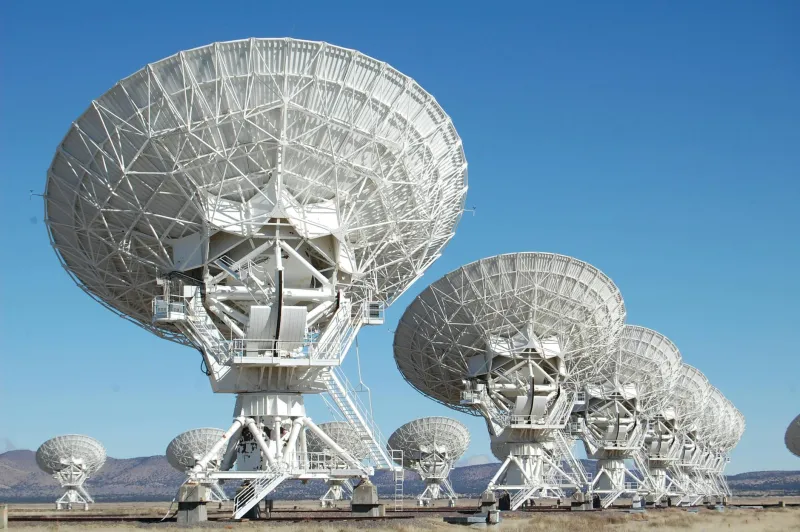
The Day Humanity Introduced Itself to the Universe
On November 16, 1974, at exactly 12:30 PM, the Arecibo Observatory in Puerto Rico aimed its massive radio telescope toward the Hercules constellation and transmitted a carefully crafted message into deep space. The broadcast lasted three minutes, carried 1,679 bits of binary code, and represented humanity's first deliberate attempt to communicate with extraterrestrial intelligence.
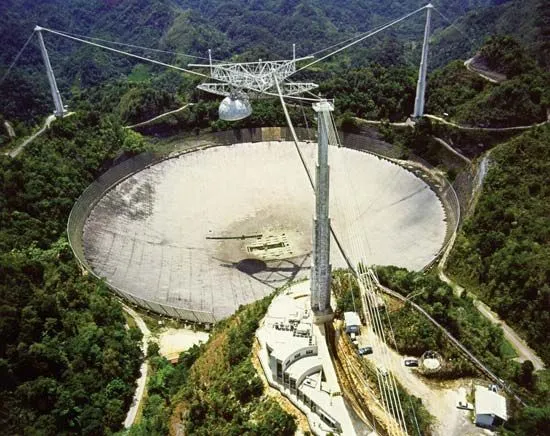 Photo: Arecibo Observatory, via cdn.britannica.com
The message contained what scientists considered a cosmic business card: basic mathematics, atomic numbers, DNA structure, human anatomy, Earth's population, and our solar system's layout. It was heading toward globular cluster M13, roughly 25,000 light-years away, where hundreds of thousands of stars might harbor planets capable of supporting life.
Dr. Frank Drake, who designed the message, called it "humanity's first postcard to the cosmos." The assembled team of astronomers, physicists, and mathematicians celebrated with champagne and congratulatory speeches about this historic moment in human communication.
 Photo: Dr. Frank Drake, via imgix.bustle.com
Then someone asked the question that would haunt the project forever: "What if they write back?"
When Celebration Turned to Contemplation
Three weeks after transmission, Dr. Carl Sagan received a phone call that would fundamentally change how he thought about the Arecibo Message. Dr. Michael Hart, a physicist at Trinity University, had spent those weeks calculating various scenarios for what might happen if the message actually reached its intended destination.
"Carl," Hart said, "we need to talk about what we just did."
Hart had identified a problem that nobody on the Arecibo team had seriously considered: the message revealed Earth's location with pinpoint accuracy. It included our solar system's structure, our planet's position relative to the sun, and even our approximate population. If any civilization received and decoded the message, they would know exactly where to find us.
"We basically sent our home address to every intelligent species within a 25,000-light-year radius," Hart explained. "And we have no idea who might be listening."
The Growing Chorus of Doubt
By early 1975, what had begun as isolated concerns from individual scientists had evolved into heated debates at academic conferences across the country. The astrophysics community split into two distinct camps: the "Optimists" who believed any civilization advanced enough for interstellar communication would be benevolent, and the "Pessimists" who pointed to human history as evidence that technological advancement didn't necessarily correlate with peaceful intentions.
Dr. Freeman Dyson of Princeton University became one of the most vocal critics of active SETI (Search for Extraterrestrial Intelligence) programs. "We're assuming that any civilization we contact will be friendly," Dyson argued at a 1975 symposium. "But we're basing that assumption on absolutely no evidence whatsoever."
The debate intensified when anthropologist Dr. Jared Diamond published a paper comparing first contact scenarios to historical encounters between technologically disparate human civilizations. "In every case where a more advanced society encountered a less advanced one," Diamond wrote, "the results were catastrophic for the less advanced group. Why would extraterrestrial contact be any different?"
The Man Who Lost Sleep Over Space Mail
Dr. Frank Drake, the message's primary architect, found himself in an increasingly uncomfortable position. What had begun as his proudest professional achievement was now being criticized as potentially the most dangerous decision in human history.
In interviews conducted decades later, Drake admitted that the growing criticism affected him deeply. "I started having these thoughts at 3 AM," he recalled. "What if we'd just painted a target on Earth? What if some aggressive civilization intercepts our message and decides we're a threat that needs to be eliminated?"
Drake began obsessively calculating timelines. Even if a hostile civilization received the message immediately and possessed faster-than-light travel technology, humanity would have at least 25,000 years to prepare for contact. But what if the message was intercepted by someone closer? What if there were relay stations or monitoring posts that could redirect the signal?
"I realized we'd sent a message into a universe where we knew absolutely nothing about who might receive it," Drake said. "It was like shouting your address into a dark forest where you know someone is listening, but you have no idea if they're friendly."
The Philosophical Earthquake
The Arecibo Message controversy fundamentally changed how scientists thought about humanity's place in the universe. Before 1974, SETI research focused primarily on listening for signals from other civilizations. The idea of actively transmitting messages had seemed like an obvious next step.
After the message's transmission, the scientific community grappled with questions that had never been seriously considered: Did humanity have the right to speak for the entire species without global consensus? Should decisions about extraterrestrial contact be made by small groups of scientists, or did they require international oversight?
Dr. Stephen Hawking later became one of the most prominent voices arguing for extreme caution in active SETI programs. "If aliens visit us," Hawking warned, "the outcome would be much as when Columbus landed in America, which didn't turn out well for the Native Americans."
 Photo: Dr. Stephen Hawking, via images.fineartamerica.com
The Message That Changed Everything
Today, nearly fifty years after its transmission, the Arecibo Message continues traveling toward M13 at the speed of light. It won't arrive for another 22,500 years, assuming it maintains its trajectory and doesn't encounter any obstacles along the way.
The debate it sparked, however, fundamentally transformed how humanity approaches the search for extraterrestrial intelligence. Modern SETI protocols now require extensive peer review, international consultation, and careful consideration of potential risks before any active transmission attempts.
The International Academy of Astronautics established formal guidelines in 2010 stating that "no response to a signal or other evidence of extraterrestrial intelligence should be sent until appropriate international consultations have taken place." The guidelines were a direct response to concerns raised by the Arecibo Message controversy.
The Cosmic Lesson
Dr. Frank Drake, now in his nineties, maintains that sending the message was the right decision. "We had to start somewhere," he says. "Humanity couldn't remain silent forever."
But he also acknowledges that the experience taught him something important about the nature of scientific discovery: "Sometimes the most significant consequences of an experiment aren't the results you're trying to achieve. They're the questions you never thought to ask until it's too late to change your mind."
The Arecibo Message remains humanity's longest-distance communication attempt, carrying our introduction to the cosmos at 186,000 miles per second toward a destination we'll never live to see reached. Whether that message will be received as a greeting, a threat, or simply cosmic noise remains one of the greatest unanswered questions in human history.
Sometimes the most profound scientific achievements are the ones that make us realize how much we still don't know — and how much we might have to lose by learning the answers.